
When many people think about baptism, and perhaps especially infant baptism, they instinctively think in personal or family terms. It’s a meaningful moment. A special day. A milestone worth celebrating. But BCO 56 gently pushes us in a different direction.
This chapter reminds us that baptism is not a private family ritual. It is a holy ordinance of Christ, administered in the public worship of the Church, governed by Christ’s appointed officers, and rich with covenantal meaning that stretches across an entire lifetime.
And if we read it pastorally, not just procedurally, what emerges is a beautiful vision of baptism as something that shapes not only the child and the parents, but the entire congregation.
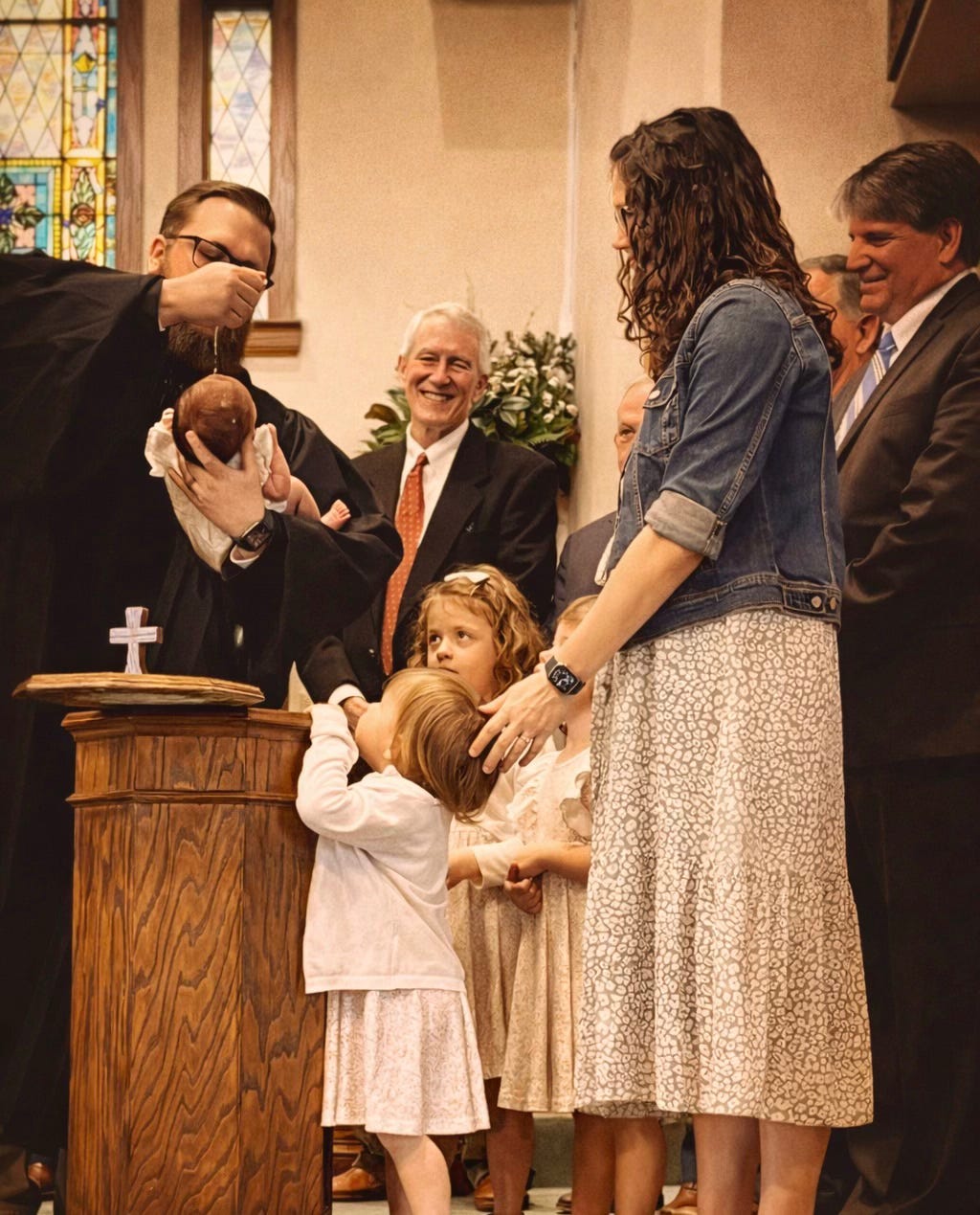
Baptism Is Not Ours to Control
One of the most striking features of BCO 56 is how quickly it removes baptism from the realm of personal preference. We are told plainly:
It is not to be unnecessarily delayed
It is not to be administered by private persons
It is to be administered by a minister of Christ
Baptism is not something we control. It is something we receive.
The restriction against “private persons” administering baptism guards us from treating baptism like a kind of spiritual mechanism. Like something that works automatically if performed correctly. Instead, it ties the sacrament to the ministry of the Word.
The same Christ who commands preaching also appoints ministers as “stewards of the mysteries of God.” Baptism is not magic. It is Word and sacrament together, administered within Christ’s Church.
The Urgency of Baptism
Baptism is “not to be unnecessarily delayed.” That phrase raises immediate pastoral questions. What counts as unnecessary? How do we avoid legalism?
We’re thinking of someone who’s made a profession of faith or somebody has been born into the church membership and baptism is expected.
The point is not to create anxiety or rigid timelines. The point is to communicate importance.
Baptism is not an optional add-on to the Christian life. It is the appointed sign and seal of entrance into the visible Church. To neglect it casually is to misunderstand what Christ has given.
But the language “unnecessarily delayed” also protects us from harshness. It leaves room for pastoral wisdom, for instruction, for preparation. The goal is faithful, meaningful administration.
Baptism Is Public Because the Church Is Public
BCO 56 also insists that baptism is not to be done privately, but in the presence of the congregation.
Baptism is the “solemn admission” into the visible Church. That means it must be visible.
A private baptism would contradict its meaning. It would say, in effect, that belonging to Christ is a private matter, detached from the Church.
This is why, even when families may request something smaller or more intimate, the Church gently but clearly insists: baptism belongs in gathered worship.
Because the child is not being welcomed into a family moment, but into the covenant community.
Preparation Matters
Before baptism ever takes place, the BCO requires “previous notice.” That may seem like a small administrative detail, but pastorally it is significant. It creates space for shepherding.
Parents are being prepared to understand what they are doing. They are being instructed in the meaning of the sacrament and the weight of their vows.
In some cases, the BCO allows for “another responsible person” to present the child. This recognizes the realities of life in a fallen world—situations where guardians or grandparents may be faithfully raising a child in the covenant.
Even here, the emphasis is not on technical qualification, but on spiritual responsibility.
The “Mini-Sermon” on Baptism
The heart of BCO 56 is found in section 56-4, where the minister is instructed to give teaching before administering baptism. It is, in many ways, a mini-sermon on what baptism means.
And notably, the minister is given “liberty and godly wisdom” in how to present it. But however he presents it, there are particular truths that must be made clear:
Baptism is instituted by Christ
It is a seal of the covenant of grace
It signifies union with Christ, remission of sins, and new life
The water points to both the blood of Christ and the work of the Spirit
It marks children as belonging to the covenant community
The grace of baptism is not tied to the moment
The child is not saved by the act itself
The benefits unfold over the whole course of life
Baptism must be explained. Without instruction, the sacrament is easily misunderstood, either reduced to sentimentality or distorted into superstition.
A Call to Remember Your Own Baptism
One of the most overlooked elements of this section is that baptism is not only about the child being baptized. It is about the everyone in the congregation.
The minister is instructed to exhort everyone present:
To look back to their own baptism
To repent of sins against their covenant with God
To renew their faith
In other words, every baptism is a moment of corporate renewal. It calls the Church to remember who we are as God’s people and what He has done for us.
The Weight of Covenant Responsibility
BCO 56 balances privilege and responsibility.
Children of believers are described as having a real place in the covenant community. They are “federally holy” and are given the sign and seal of that reality.
But the chapter is equally clear that baptism is not enough by itself. Section 56-4.j reminds us that covenant membership must be personally embraced:
Faith
Repentance
Obedience
Without these, one becomes a covenant breaker. This is an important pastoral note for parents. Baptism is not a guarantee of salvation. It is a call to discipleship.
Covenant Promises and Parental Vows
After instruction comes the reading of Scripture and the taking of vows. The minister reads covenant promises from Acts, Genesis, and elsewhere. The minister reads these covenant promises as a reminder of what God’s doing and has done.
This is crucial. Baptism begins not with our promises, but with God’s promises.
Then the parents take vows. They acknowledge their child’s need of grace. They claim God’s promises. They commit to raising the child in the faith.
These vows push back against any notion that baptism is automatic or mechanical. Baptism is not just a thing we do and hope beyond hope that it takes. There’s work involved on our part as parents and as the church. The vows make explicit what is already implied: raising a covenant child is a holy responsibility.
The Role of the Congregation
The BCO includes an optional congregational vow: “Do you… undertake the responsibility of assisting the parents…?”
Though optional, this question reminds us that Christian nurture is not a solo project. The Church shares in the responsibility. It means:
Teaching in Sunday school
Modeling godliness
Encouraging faith
Praying for covenant children
Every baptized child belongs not just to their nuclear family, but to the chruch family as well.
The Simplicity of the Sacrament
Finally, BCO 56 closes with the actual administration of baptism. And what stands out most is its simplicity.
The Trinitarian formula is spoken
Water is applied (by pouring or sprinkling)
No additional ceremonies are added
This simplicity is intentional. It keeps the focus on what Christ has appointed: Word and sign. Nothing more is needed. Nothing should distract.
Baptism for the Life of the Church
If we step back and look at BCO 56 as a whole, a clear picture emerges. Baptism is:
God’s ordinance, not ours
Public, not private
Instructional, not automatic
Covenantal, not merely symbolic
Communal, not individualistic
Simple, not elaborate
And perhaps most importantly—it is ongoing in its significance. Baptism is not a moment we leave behind. It is a reality we grow into. Every time we witness a baptism, we are reminded:
We belong to Christ
We have been set apart
We are called to faith and repentance
In that sense, baptism is not just for the child. It is for the whole Church. And it calls us, again and again, to live as those who have been marked by the name of the Father, and of the Son, and of the Holy Spirit.